

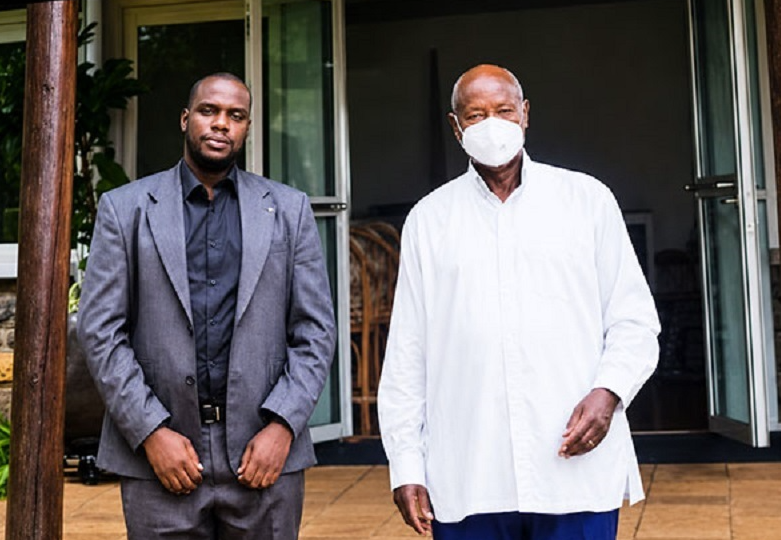
Ugandan President Yoweri Kaguta Museveni has said that Stephen Nuwagaba, a young man who has been in the news for a while, is not a major problem for the country as some have suggested, but rather a person who came to him after being tortured and abused by security forces.
In a message on the X website on August 3, 2026, Museveni said he wanted to explain the truth about Nuwagaba to the public, after journalist Andrew Mwenda revealed that the young man had become a threat to national security and had taken over the office of the Head of State and security agencies.
Museveni said that Nuwagaba is a young man in his 20s who came to him as a fugitive and was tortured, with some security personnel accused of trying to silence him and even take his life.
He said, “These alleged torturers and criminals wanted to kill Nuwagaba; they also attacked, tortured, and abused his mother, who is a staunch NRM supporter, and called his father, who was recently elected unopposed in the village for another term as LC-1, and intimidated him.”
He said the young man had been receiving treatment for injuries and trauma caused by the incident, which required him to be referred to hospitals in Uganda and abroad for treatment. Museveni said his health was improving, although he still showed signs of the incident.
The Ugandan president said that reports of Nuwagaba being tortured would continue to be investigated, explaining that some of those suspected of involvement in the atrocities would be brought to justice.
Condemns torture in security forces
In the message, President Museveni stressed that torture, ill-treatment or killing are not in line with the values of the NRA militants who seized power in 1986.
He reminded Ugandans of the atrocities that characterized the Idi Amin regime and the country’s liberation struggle from 1981 to 1986, noting that many lost their lives fighting to escape a history of killings and torture.
Museveni said that those who fought for change did not do so so that such acts would recur in the country. He added that security forces, while fighting crime, must do so in a manner that respects the law.
“However, while security forces must fight criminals and end impunity, they must not commit crimes that involve torture or killing people.”
“Uganda’s Problem Is Not Nuwagaba”
Museveni said that the main problem in Uganda is not Stephen Nuwagaba, but some people in government and security agencies who may be corrupt or conceal information about crimes being committed.
He said that there are people who use their positions in various institutions to prevent such information from reaching senior officials, which allows some to continue to commit illegal acts.
He said, “Those who focus on Nuwagaba as a major problem are ignoring other major problems including corruption, mismanagement of government programs and other activities that are destroying the country.”
Museveni said that if Nuwagaba is guilty of wrongdoing, is lying, pretending to have powers he does not have or other illegal activities, he will be held accountable by the law. However, he said that this should not be used as an excuse to cover up or ignore the crimes committed against him.
Non-intelligence sources
Museveni also stressed the importance of information provided by people outside the intelligence community, saying that sometimes such information helps the leadership to identify problems that may not have reached the leaders.
The Head of State said that when the regular institutions do not fulfill their responsibilities, there are other people who can provide information that helps the country.
He said that even during the liberation struggle of Uganda, the NRA used various methods to obtain information including those provided by people close to the enemy and electronic espionage methods.
Museveni said that he was happy to have helped Nuwagaba and his family, but stressed that if the young man did anything illegal, he would also be held accountable.
The Ugandan President expressed his position on the issue three days after it was announced that Nuwagaba was arrested after paying a ransom, while he was in a vehicle guarded by Special Forces (SFC) soldiers.
The news of Nuwagaba’s arrest followed several stories, including one published by Andrew Mwenda, which claimed that the young man managed to convince the generals’ soldiers, after pleading with them that he had been tortured while in detention by the intelligence service.
It was reported that Nuwagaba had approached Museveni about this matter, but that during all these times he had used the opportunity to be arrested by the Head of State to intimidate some members of the Government, and that he also had forged documents, including two passports with different names.